4/30/08

Wednesday news bites for April 30, 2008

Fry holder for your car:
I'd like to point out that Wendy's fries packages require no extra equipment. They fit in standard cup holders just fine.

Shopping solutions: Strategies for stretching your food dollar
A wrap-up of recent news and online articles with practical advice about eating on the cheap

Peak Water: Aquifers and Rivers Are Running Dry. How Three Regions Are Coping
Like oil, we have a finite amount of water. The thing is, oil can be replaced. Water, not so much.

Environmental Cost of Shipping Groceries Around the World
Cod caught off Norway is shipped to China to be turned into filets, then shipped back to Norway for sale. That pretty much says it all.

Recession Diet Just One Way to Tighten Belt
Changing your food habits is one way to save money in this shrinking economy

Bombs, Bullets and Our Daily Bread and Militia, bandits, one meal a day
Feeding (or choosing not to feed) refugees.

4/29/08

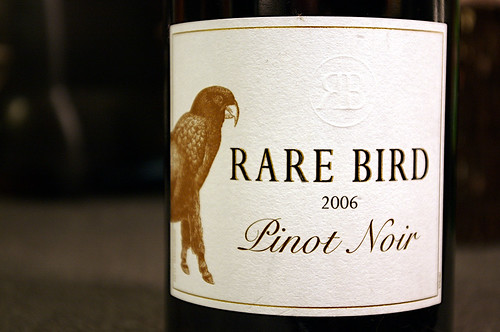
2006 Rare Bird pinot noir

IMGP4542

Color: Like many a pinot noir, the Rare Bird pinot is a lustrous, translucent ruby fading to salmon at the edges
Nose: Very fresh smelling with hints of cranberry, earth, greenery and slight flowery overtones
Palate: Wonderful, light mouth feel with good but not strong tannins. Excellent flavors of fruit with no overpowering alcohol heat
Finish: Sweeping and clean with few lingering flavors

This is a marvelous little wine that's versatile enough to be paired with many different meals from soups and pastas to sandwiches, roasted chicken, and some grilled steaks.. It probably wouldn't stand up to heavier meals, like bbq or steak au poive, but as an everyday wine to have with most meals, this is a delicious, affordable wine that many will enjoy.

From Culinate: Rules for the home kitchen

An excellent article and 8-item list (though I tend to hate n-item blog lists) from Eric Gower. Of note? Number 5:

5. Be fearless. Courage is crucial to cooking well. As in many areas of life, fear of doing things incorrectly induces paralysis; this is devastating in the kitchen, because we wind up being too hungry to deal and just go out, order in, or pull out the TJ’s quasimeal.

But how is fearlessness learned? By not caring. It sounds paradoxical, but think about it: What’s the absolute worst thing that could happen by taking risks with your cooking? That it ruins the dish? Well, yes, but you will have learned something valuable in the process. And if you’re anything like me, you abhor wasting food, and will do everything in your power to bring it back from the brink.

Too salty? Add some sliced potatoes, which will absorb the extra salt. Too bitter? Consider adding a sweetener like jam or maple syrup. Learn to “repair” mistakes you make. So much about cooking is about salvaging things that go wrong. Along the way, you learn. But you have to be bold and take some risks. It’s just food, after all. [ more... ]

Fearlessness is one thing I've tried to incorporate into my own cooking. There's nothing wrong with messing up. In fact, messing up should be expected and even welcomed. Those mistakes can be the greatest learning opportunities. Remember my potato cakes? Though it took over 12 hours of thinking about it, I was able to solve the problem and came up with a delicious snack I could be proud of. I was also ridiculously proud of myself and tromped around the kitchen clapping like someone enfeebled. So go on. Take risks. Put fennel in your lentils (actually, don't). Just stop being afraid of the kitchen and get to it.

4/23/08

Wednesday news bites for April 23, 2008

A Drought in Australia, a Global Shortage of Rice
Six years of drought have reduced Australia’s rice crop by 98 percent. "The collapse of Australia’s rice production is one of several factors contributing to a doubling of rice prices in the last three months — increases that have led the world’s largest exporters to restrict exports severely, spurred panicked hoarding in Hong Kong and the Philippines, and set off violent protests in countries including Cameroon, Egypt, Ethiopia, Haiti, Indonesia, Italy, Ivory Coast, Mauritania, the Philippines, Thailand, Uzbekistan and Yemen."

One less burger, one safer planet
Seems like good news and bad news: "Scientists are concluding that along with more fuel-efficient cars and curbing industrial pollution, the simple act of eating less meat could help slow global warming."

Just in time: how to peel ginger

From the fine folks at Chow.com.

4/22/08

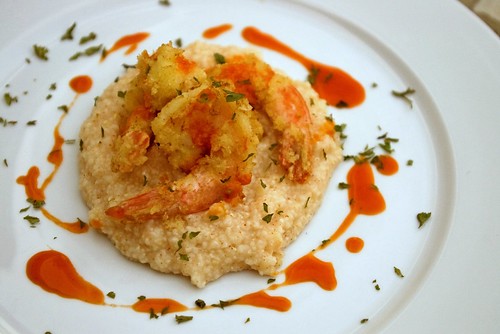
Spicy ginger shrimp and grits

Ginger shrimp and grits

Shrimp and grits has long been a staple meal in the American south, marrying West Africa cooking methods with ingredients introduced by the American Indians. From the port town of Charleston it spread down the coast and rimmed the Gulf of Mexico. And if you’re not familiar with grits, you’re missing out.

This recipe turns the traditional meal on its head, opting for a tempura-like ginger shrimp, based on Michael Symon’s fried calamari recipe, coupled with a little heat in the form of cayenne pepper. The final result is a dish that is at once familiar but definitely leans towards the exotic.

Ingredients

  • 12 large shrimp, peeled and deveined
  • 2 medium ginger lobes
  • Equal parts all purpose flour and panko bread crumbs (1.5 cups, total)
  • 1 egg
  • 16 oz. high-quality ginger ale
  • Canola or peanut oil
  • 1 cup grits (traditional stone ground, if you can find them. Here, I used quick grits. Instant grits are totally unacceptable)
  • 3 cups water
  • 1 teaspoon cayenne pepper
  • Salt
  • Srirache (sp) sauce (in a pinch, a good buffalo sauce will do nicely)

Optional

  • Maple sugar
  • Additional ginger ale

Peel and devein the shrimp, and peel and slice the ginger. (When peeling ginger, it's best to use a spoon, scraping the peel from the flesh. It works very well and enables you to get into the roots' nooks and crannies.) Place the shrimp in a non-reactive container, pour in enough ginger ale to cover the shrimp and add the sliced ginger. Let this sit for at least six hours.

Before you begin, you’ll want to make sure you have everything set for frying the shrimp. Beat the egg and leave in a bowl large enough to fit most of the shrimp. In a separate bowl, combine the flour and panko and add a dash of salt. Pour about two inches of oil into the bottom of a sturdy pot.

Remove the shrimp from the ginger ale and pat dry.

Make the grits as per the directions on the package, though shy away from butter and cream for this recipe. For quick grits, whisk 1 cup (dry) grits into 3 cups of rapidly boiling water. Reduce the heat to low and cover the pot. Simmer for five to seven minutes, then mix in the cayenne pepper.

Note: To add a little sweetness to your grits, you might want to try adding a touch of maple syrup. Or, if you’re feeling especially adventurous, you could use the ginger ale instead of a water portion—one-third cup, for example. I haven’t tried either of these variations yet, so you’re on your own. If you do try them, however, I’d love to hear about the results.

As the grist finish cooking, heat the oil you poured earlier to 350F. Toss the shrimp in the egg mixture to coat them, then dredge in the flour and panko mixture. When the grits have finished cooking, remove them from the heat. Then, begin frying the shrimp. Work in batches and drain on paper towels or a wire cooling rack. They fry up very quickly--about a minute per batch, so you’ll want to stay on top of things. To plate, spoon a dollop of grits onto the center of a plate, place several shrimp on top of the grits and hit the whole thing with a couple squirts of the srirache. The mixture of sweetness from the ginger ale and spice from the hot sauce is wonderful, complex, and just the thing for a breezy spring evening on the patio.

4/21/08

World food shortage has Haitians eating mud to stave off hunger

From the New York Times:

Saint Louis Meriska’s children ate two spoonfuls of rice apiece as their only meal recently and then went without any food the following day. His eyes downcast, his own stomach empty, the unemployed father said forlornly, “They look at me and say, ‘Papa, I’m hungry,’ and I have to look away. It’s humiliating and it makes you angry.”

That anger is palpable across the globe. The food crisis is not only being felt among the poor but is also eroding the gains of the working and middle classes, sowing volatile levels of discontent and putting new pressures on fragile governments.

***

Real solutions will take years. Haiti, its agriculture industry in shambles, needs to better feed itself. Outside investment is the key, although that requires stability, not the sort of widespread looting and violence that the Haitian food riots have fostered.

Meanwhile, most of the poorest of the poor suffer silently, too weak for activism or too busy raising the next generation of hungry. In the sprawling slum of Haiti’s Cité Soleil, Placide Simone, 29, offered one of her five offspring to a stranger. “Take one,” she said, cradling a listless baby and motioning toward four rail-thin toddlers, none of whom had eaten that day. “You pick. Just feed them.” more...

It has never been more evident that food is what brings people together. It is what keeps them content. Without it, the world literally comes apart at the seams. I have no ideas about what can be done to help alleviate the crisis, but I do know this: next time you think of complaining because you can't decide what to have dinner, be glad you have dinner at all.

4/16/08

Wednesday News bites for April 16, 2008

Is high-fructose corn syrup natural?
According to the FDA, obviously caving to lobby pressure, it just might be.

CASH COWS & COWBOY STARTER KITS
BILL MOYERS JOURNAL teams up with the PBS series EXPOSÉ: AMERICA'S INVESTIGATIVE REPORTS to follow the trail of Washington Post reporters who uncovered more than $15 billion in "wasteful, unnecessary, or redundant expenditures" that have flowed from Washington to America's farmers.

Can People Have Meat and a Planet, Too?
A startling tale of ethics, environment and engineered meat. How about this: how about we stop going the direction of Frankenstein and move to less consumption, more humane ranching practices, and more balanced eating?

Speaking of which, Shop and eat locally: Wired HOWto wiki
Nice!

4/15/08

Visions of past futures: Kitchen, 1999

My favorite futures are the ones already imagined:

4/12/08

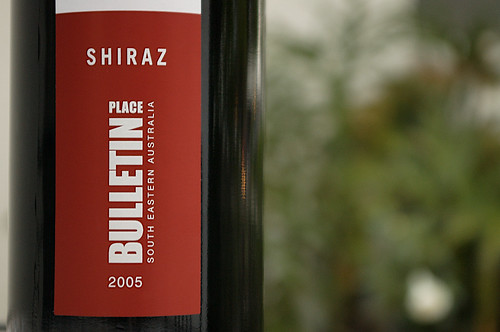
Cheap-ass Wine: 2005 Bulletin Place Shiraz

2005 Bulletin Place Shiraz

It's tax season. If you played your cards right (or are crooked), then it's smooth sailing and Stag's Leap for you. If not--well, there's always some cheap-ass wine:

Color: Deep, blood red fading to purple at the edges.
Nose: Berries! A little rhubarb, a little cranberry and a little greenery or vegetation. Just a hint of smoky leather.
Palate: This is a big wine with rich berry favors--cherry, blueberry. Large body and good tannic structure.
Finish: Lingering fruit and a fair amount of alcohol heat.
Pairings: This seems like a fairly versatile wine. It paired excellently with mojo-roasted chicken (mojo is a Latin American sauce made with coriander seeds, black peppercorns, salt and other ingredients) and polenta. It would also work well with roasted pork, and many Italian dishes. It's lithe mouth feel might fall against heavy steaks or lamb.

You know, cheap-ass wine doesn't mean the wine is categorically bad. And bad wine doesn't even mean it's categorically bad. Someone's drinking the stuff, or it wouldn't get bottled and sold. But I think there is a difference between wines you can get at your local supermarket and wines you can get at your local wine merchant. Given a choice always go for the wine merchant.

In Gainesville, we have a great resource in Dorn's Liquors. The staff there are knowledgable and the buyers maintain an exhaustive tasting schedule, brining the store excellent values and some damn fine wines. I bought he Bulletin Place Shiraz and the Three Thieves Syrah at Dorn's and wasn't disappointed with either. The Bulletin Place Shiraz, in fact, was a really good, fun wine. Perfect for a party or spring bbq.

I've bought cheap-ass wine at the grocery store. One time I came away with a Little Penguin white shiraz that was sweet to the point of cloying and absolutely bereft of backbone. It was a high-schoolers' wine, clearly, and left me feeling like I'd had a handful of Jolly Ranchers muddled in maple syrup. Never again. So next time you're going for wine, seek out your local wine merchant. Hopefully, they'll steer you in the right direction, cheap-ass or otherwise.